(versione italiana qua)
In a recent article of mine I discussed the relationship between informatics and coding in the context of school education. This sparked an interesting debate on social media, in which some people took the side of coding and others that of informatics. Since coding (that is, computer programming) is a part of informatics (as discussed here, here, and here), I think it is worth hearing an authoritative perspective on what should actually be taught in schools.
Last November, the G-20 Education Ministers met in Argentina. On the occasion of this gathering, devoted to sustainable development, the challenges of digital literacy were addressed: Hadi Partovi, founder and CEO of Code.org, delivered a passionate speech on what needs to be done to properly prepare young people for life in a digital society.
After reaffirming that the teaching of mathematics and other sciences is fundamental, Partovi argued that, just as we teach children how to do long division and how the human body works, it is equally important to teach them what algorithms are and the principles underlying how the Internet works. The trouble is that schools around the world tend to focus almost exclusively on how to use digital technology. Instead, we need to teach how to create, understand, and harness this technology. To that end, he explicitly argued that students need to learn informatics. Below is an image of the key passage of his speech.
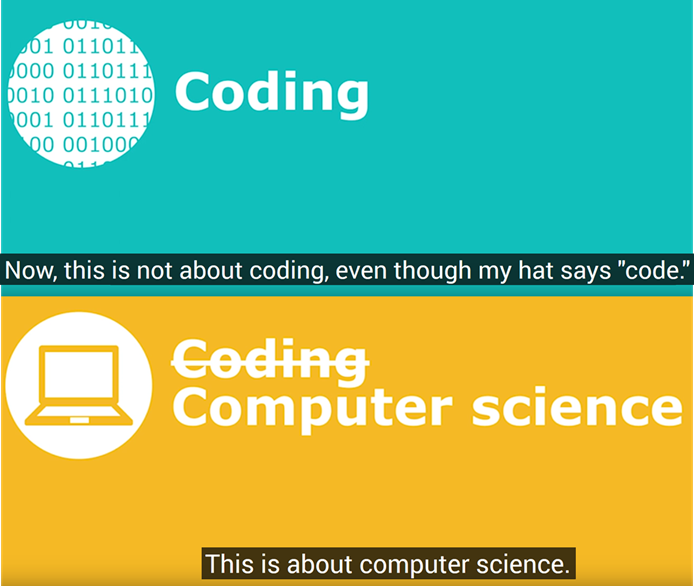
He stressed that the focus should not be on learning coding, despite his organization being called, precisely, Code.org. The real goal is to learn informatics (he used the term computer science, the English equivalent of informatics), a scientific discipline that, he reminded his audience, «includes programming, algorithms, data science, networking, cybersecurity, robotics, and artificial intelligence», among much else.
I should note that Code.org launched what has become the most widely participated educational event in the world, the Hour of Code — in which students are essentially encouraged to write computer programs — turning coding into a global mass phenomenon. Through Programma il Futuro, the project I coordinate, Italy is, after the United States, the second most participating country in the world, thanks to the dedication of the teachers enrolled in the project.

So, despite Hadi Partovi being perhaps the chief architect of the "coding craze," he is firmly convinced — and said so in front of the G-20 Education Ministers — that the answer is not to teach coding, but informatics. Here is his full speech dubbed in Italian. More recently, Partovi reiterated the same position in a speech at the World Economic Forum in Davos. Thanks to the work of Code.org and the CSforAll coalition ("Informatics for All" — which includes all the major American companies operating in the technology and informatics services sector), the United States has added informatics (not coding!) to the subjects that federal school legislation requires to be taught to all students, and 44 out of 50 states have introduced it as a compulsory subject in their curricula.
It is therefore essential to keep pressing for the importance of serious scientific education in informatics from the very first years of school. To this end, the university informatics community has long since submitted a comprehensive proposal to the Ministry of Education, grounded in extensive, years-long field experience. We are well aware that this is no simple undertaking within the context of the Italian school system. But let us imagine for a moment wiping the slate clean on existing curricula and asking ourselves what we would fill that blank page with in order to prepare citizens capable of navigating digital society with an adequate understanding of the issues at stake. Can we afford to leave out the science that both explains and makes possible this society?
The Italian Chamber of Deputies recently debated initiatives to promote technological and digital education in schools, but — while I am well aware that the language of politics differs from that of science — I note that there is still much work to be done in terms of spreading an accurate understanding of the relevant terminology and of the experiences that have already been carried out.
--The original version (in italian) has been published by "Il Fatto Quotidiano" on 20 March 2019.


Nessun commento:
Posta un commento
Sono pubblicati solo i commenti che rispettano le norme di legge, le regole della buona educazione e sono attinenti agli argomenti trattati: siamo aperti alla discussione, non alla polemica.